Haeger Member
Lithostratigraphy: Wedron Group >>Lemont Formation >>Haeger Member
Chronostratigraphy: Cenozoic Erathem >>Quaternary System >>Pleistocene Series
Primary source
Hansel, Ardith K., and W. Hilton Johnson, 1996, Wedron and Mason Groups: Lithostratigraphic Reclassification of Deposits of the Wisconsin Episode, Lake Michigan Lobe Area: Illinois State Geological Survey Bulletin 104, 116 p.
Contributing author(s)
Ardith K. Hansel and W. Hilton Johnson
Name
Original description
Haeger Till Member (Willman and Frye 1970).
Derivation
Haegers Bend, a village along the Fox River in McHenry County.
Other names
History/background
The Haeger Till Member of the Wedron Formation was originally defined by Willman and Frye (1970) and described as a silty, sandy, gravelly till interstratified with sand and gravel outwash. It was mapped as a surface unit in the Harvard Sublobe area. Although they defined the upper boundary of the Haeger Till Member as the contact with the Wadsworth Till Member, uncertainty existed regarding whether sandy Haeger till graded southward into clayey Wadsworth till or was overlapped by it. Later studies supported the overlap interpretation and extended the unit into the subsurface of northeastern Illinois. The unit was correlated with the Lemont drift and reclassified as part of the Lemont Formation.
-
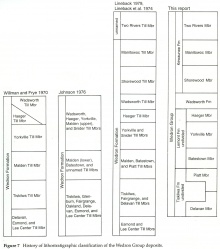 Figure 7 -- History of lithostratigraphic classification of the Wedron Group deposits.
-
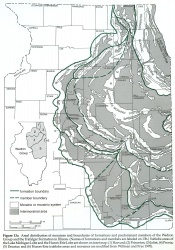 Figure 13a -- Areal distribution of moraines and boundaries of formations and predominant members of the Wedron Group and the Trafalgar Formation in Illinois. (Names of formations and members are labeled on 13b.) Sublobe areas of the Lake Michigan Lobe and the Huron-Erie Lobe are shown on inset map: (1) Harvard; (2) Princeton, (3) Joliet; (4) Peoria; (5) Decatur; and (6) Huron-Erie (sublobe areas and moraines are modified from Willman and Frye 1970).
-
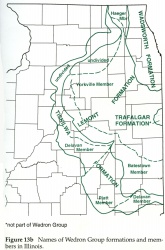 Figure 13b -- Names of Wedron Group formations and members in Illinois.


The Haeger Member consists of sandy loam diamicton that commonly contains lenses of sorted sediment. It is typically underlain by a coarsening-upward sequence of sand and gravel classified as the Beverly Tongue of the Henry Formation.
Type section
Type location
Roadcuts along the Algonquin-Cary Road, 0.5 mile northwest of Haegers Bend.
Type author(s)
Type status
No longer exposed.
Reference section
Reference location
Beverly Sand and Gravel Pit Section; good for lithology and lower contact.
-
 Figure 19 -- Diamicton (subglacial till) of the Haeger Member of the Lemont Formation overlies the proglacial (ice proximal) sand and gravel of the Beverly Tongue of the Henry Formation at the Beverly Sand and Gravel Pit Section.

Reference author(s)
Reference status
Stratigraphic relationships
The Haeger Member is the coarse-grained uppermost diamicton unit of the Lemont Formation. It is typically oxidized to yellow brown in surface exposures and is light gray in the subsurface. It overlies a coarsening-upward sand and gravel sequence and is overlain by the Wadsworth Formation.
Extent and thickness
The Haeger Member forms a wedge-shaped deposit in the Harvard Sublobe area and is generally less than 10 meters thick, thinning significantly in northeastern Illinois and southeastern Wisconsin.
-
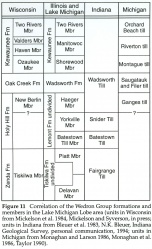 Figure 11 Correlation of the Wedron Group formations and members in the Lake Michigan Lobe area (units in Wisconsin from Mickelson et. al. 1984, Mickelson and Syverson, in press; units in Indiana from Bleuer et al. 1983, N.K. Bleuer, Indiana Geological Survey, personal communication, 1994; units in Michigan from Monaghan and Larson 1986, Monaghan et al. 1986, Taylor 1990).

Lithology
The Haeger Member consists of calcareous, coarse-textured sandy loam diamicton containing lenses of sand, gravel, silt, and clay. It commonly overlies a coarsening-upward sequence of stratified sediment.
Core(s)
Photograph(s)
Contacts
Lower boundary: contact with underlying Lemont Formation units or Henry Formation deposits. Upper boundary: contact with the Wadsworth Formation or younger deposits.
Well log characteristics
Fossils
Age and correlation
The Haeger Member was deposited during the Woodstock Phase of the Michigan Subepisode.
-
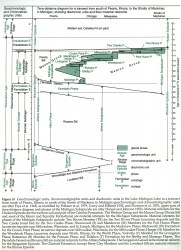 Figure 10 -- Geochronological units, chronostratigraphic units and diachronic units in the Lake Michigan Lobe in a transect from south of Peoria, Illinois, to north of the Straits of Mackinac in Michigan (geochronologic and chronostratigraphic units are after Frye et al. 1968, as modified by Follmer et al. 1979, Curry and Follmer 1992, and Evenson et al. 1976; upper part of time-distance diagram and phases of the Michigan Subepisode are after Hansel and Johnson 1992).

Environments of deposition
The Haeger Member represents subglacial and ice-marginal deposition within a glacigenic sequence that includes proglacial, lacustrine, and fluvial sedimentation.
Economic importance
Remarks
Reclassified unit.
References
(unchanged)
ISGS Codes
| Stratigraphic Code | Geo Unit Designation |
|---|---|
|
0420 |
l-h |